About Edmodo:
Edmodo is a social learning network for students, teachers, and parents. A teacher creates a group for each class and distributes the group code to each student. Once connected, students can write posts to classmates, teachers, and parents and upload media as well as view grades, submit assignments, and receive teacher feedback, features sites such as BlackBoard and Moodle utilize. The Edmodo community combines the efforts of students, parents, teachers, and school districts to help education appeal to students’ ever-increasing technological tastes. Edmodo is an addition to the classroom that will promote learning all hours of the day.
Edmodo.com
Positives:
Negatives:
Prezi Presentation:

Saturday, March 17, 2012


The SMART Board (Pros)
The SMART board has begun to find its way into classrooms across the country, especially as the growth of technology heightens. The SMART board is essentially a modern day projector that connects itself with a computer inside of the classroom. Whatever is projected on the computer’s screen is also projected on to the SMART board; however, with this board, the teacher is able to do much more. This board is touch screen and can be operated by one’s finger or the pen provided with the board. Therefore, a teacher can open a presentation created on the computer, make notes on top, record the presentation, and then email the notes to the class. This could potentially allow students to focus more on class involvement than writing the notes down since the teacher can send them out to the class. The SMART board provides amazing opportunities educationally. First, the board provides interactive learning. Children in the classroom are able to work on this board while the rest of the class is engaged. Essentially, the board is the modern dry-erase or chalkboard. Secondly, this board uses multimedia to adapt to all learning styles. Sound bytes, pictures, videos, lectures, and text are all available for use on this board. Third, this board only requires one computer that operates with Windows software, so educators do not have to spend too much money on computers for the entire class. All that is needed is a simple PC. In order to be adaptable in our education, schools will begin to implement technology into the classrooms in big or small ways, and this board is a great way to do so.
In The Proust and the Squid, Wolf expresses her concerns about the implications associated with the rapid growth technology. She questions that the rapidity associated with technological growth may cause humans to find less satisfaction in reading long text and may have attention issues. Oppositely, she proposes the ideas that because of technology’s fast-paced style, humans may be able to complete tasks more quickly and, in turn, spend more time on in-depth thought. Secondly, people may become better at multi-tasking (Wolf 214). The educational opportunities provided by the SMART board both appease Wolf’s worries as well as support her positive implications. Because the SMART board is used for educational purposes, it’s a great way to bridge the gap between a non-technological world and an entirely technological one. As we move forward, classrooms will have to adapt to at least some form of technology, as it is relevant to today’s real world. However, this board still allows children to learn proper reading skills as well as learn to use technology to complement their learning styles. If used properly, this device can only support children’s learning needs.
Thursday, March 15, 2012
Cell Phones
As time has moved on, and technology has progressed, our ability to communicate across the world has opened new doors, and removed long-existing land barriers. Ecomonmies changed forever, and loved ones could live further away without losing contact with one another. No invention has better served this purpose than the telephone.
The telephone has it's issues, but many of which were later solved with the introduction of the cell phone. It was suddenly possible to live at all times without ever being unreachable. You could be anywhere in the world and connect with anyone else, at any given time.
Today, in the U.S alone, 278.9 million people subscribe to a cell phone service. By comparison, there are 309 million people alive in the U.S according the 2000 census data.
Now that cell phone have become so unanimous, their implications have become more and more wide-spread. Check out our Prezi for the details:
The telephone has it's issues, but many of which were later solved with the introduction of the cell phone. It was suddenly possible to live at all times without ever being unreachable. You could be anywhere in the world and connect with anyone else, at any given time.
Today, in the U.S alone, 278.9 million people subscribe to a cell phone service. By comparison, there are 309 million people alive in the U.S according the 2000 census data.
Now that cell phone have become so unanimous, their implications have become more and more wide-spread. Check out our Prezi for the details:
Cellphones and their effects on human development. on Prezi

There are several ways this influences out lives and well-beings. For one thing, the World Health Organization now believes that there may be a link to cell phones and brain cancer. (Though their research may be flawed...)
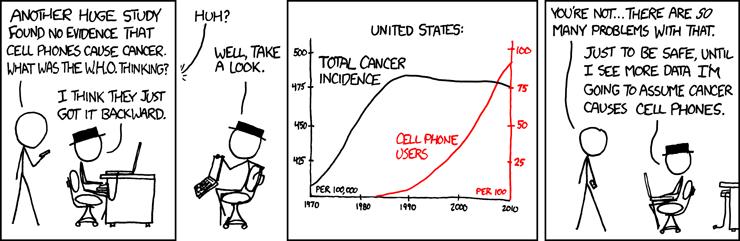
Not to mention, I would personally trade a slightly increased risk of brain cancer for constantly available 911 access.
Something else to think about, a person's cell phone is always in reach. It has become impossible to escape our friends, family, or the entire world. With the internet connectivity they offer, Google, Facebook, MySpace (if you still use that, get with the times), eBay, and every other notable web service sit right in your pocket, just waiting for the urge to hit you to browse, surf, and communicate.
The cellphone brings lots of positives and negative to the table, but let's be honest, even if they shorten our live expectancies, cell phones aren't going anywhere.
Monday, March 12, 2012
What the Internet has done to our brains. A comic.
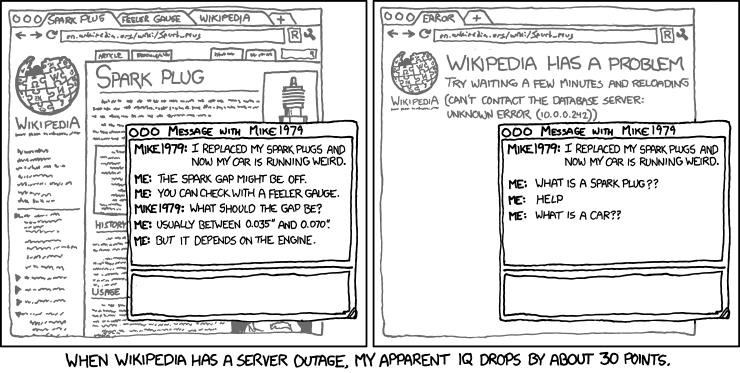
Just something I thought you guys might enjoy! Seemed at least a little relevant to the class.
Wednesday, March 7, 2012
Rock Prodigy (Not cool)
The "not cool" aspect of the product itself includes syncing, recording, and clustering. In order for the iOS device to recognize the notes and chords being played, it must record through either its built-in mic or an external mic attached to it. This can lead to delay and lag between the audio input of the guitar and the video output from the iOS device. The faster the song, the more difficult it will be to account for the faults in the syncing as the user's timing will not be perfectly in-time with the notes on the screen. This may be further amplified by the fact that it can be difficult for the built-in mic to pick up all the sounds coming from the guitar, thus needing the guitar to be played relatively close to the iOS device at all times. Any sound that is not recorded will be considered a missed note and an error.
User
reviews have claimed that the notes on the screen as seem clustered at
times. This is a combination of being limited to a small screen as well
as having a continuous stream of multiple notes flying across the screen
that are challenging to individually distinguish.
There
are limitations on Rock Prodigy's functionality, one of which being
only being compatible with iOS devices. That means that a large number
of people will be unable to use the application
simply due to lack of access to an iOS device, or people will have to
spend more money to purchase a compatible device, which seems unlikely
that they would do so in order
to just be able to use Rock Prodigy. More costs are added to the use of
this application as users have to buy songs that they want to play.
Each song costs a minimum of $0.99 and there is a limited number and
variety of songs that are available for users to purchase and learn. In
other words, users cannot use Rock Prodigy to learn any song that they
would like to learn as they can only buy and download songs that have
been programmed and listed on the list available for purchase. This
problem is not aided by the fact that users cannot program their own
songs into the format that is used in Rock Prodigy, thus further
limiting the number of songs users can learn.
The implications of Rock Prodigy and its technology may be harmful additions to the accelerating transition to a technological and digital-dependent society. Learning how to play the guitar from Rock Prodigy is significantly different from the traditional way of learning how to play an instrument, using sheet music. As a result, new learners will be unable to understand the theory behind music and never gain the ability to sight-read, transcribe music, or teach themselves another instrument, all of which are possible with a true understanding of how sheet music works. The learner will become too overdependent on the application and on the iOS device that they cannot play the guitar without them, making it inconvenient and inflexible.
Nicholar Carr in The Shallows discusses this idea that we are becoming overdependent on technology and further distancing ourselves from the traditional methods. He says that technology and the internet is changing the way our minds function and that he is unable to focus when reading long-passages or articles, and instead finds himself skimming and skipping from places via hyperlinks. It is sad that we are unable to grasp a full and rich understanding of things the more we rely on technology and in terms of music, we are losing the appreciation of its beauty as an expression of art.
The implications of Rock Prodigy and its technology may be harmful additions to the accelerating transition to a technological and digital-dependent society. Learning how to play the guitar from Rock Prodigy is significantly different from the traditional way of learning how to play an instrument, using sheet music. As a result, new learners will be unable to understand the theory behind music and never gain the ability to sight-read, transcribe music, or teach themselves another instrument, all of which are possible with a true understanding of how sheet music works. The learner will become too overdependent on the application and on the iOS device that they cannot play the guitar without them, making it inconvenient and inflexible.
Nicholar Carr in The Shallows discusses this idea that we are becoming overdependent on technology and further distancing ourselves from the traditional methods. He says that technology and the internet is changing the way our minds function and that he is unable to focus when reading long-passages or articles, and instead finds himself skimming and skipping from places via hyperlinks. It is sad that we are unable to grasp a full and rich understanding of things the more we rely on technology and in terms of music, we are losing the appreciation of its beauty as an expression of art.
Sunday, March 4, 2012
Proton Ion Sequencer: What's (very) cool
Proton Ion Sequencer on Prezi
Follow along with my Prezi presentation!
The
Proton Ion sequencer is a revolutionary new biological technology. It uses
semi-conductor sequencing, a seemingly complicated method which codes AT/CG
using the charge of each respective base, to quickly and inexpensively sequence
any DNA. This technology is particularly impressive because it cuts time and
costs involved with coding: what previously took weeks or longer can now be
done in literally 24 hours, and what previously cost $10,000 now only costs
$1,000 for one sequence. What is particularly amazing is the cost of the
machine itself, as it only costs $149,000 to purchase a Proton Ion Sequencer.
While that may seem steep, that is comparatively free when faced with the
half-million it costs to purchase a different technology for sequencing. This
lowered cost allows for a broader consumer base, letting more and more
researchers and physicians purchase the device and investigate the seemingly
limitless bounds of genetic codes. In fact, LSU owns a Proton Ion Sequencer, so
groundbreaking, inexpensive, and fast research is being done on our very own
campus every day.
The types of things that can be
discovered through quick and inexpensive DNA sequencing are boundless. First,
it can be used for early detection and prevention of diseases. It has been said
that genetics load the gun, but environment pulls the trigger, so knowledge of
genetic predispositions is invaluable. Newborns can be screened (i.e., their
DNA is processed and checked for known signs) for diseases like cystic fibrosis,
sickle-cell anemia, PKU, and hypothyroidism and treatments can be instituted
immediately. In the book, “The Language of Life” by Francis S. Collins, he
discusses the benefits of such screens: “While hypothyroidism is generally not
due to a single genetic cause, early detection is critical. If your child has
hypothyroidism, it is essential to replace thyroid hormone immediately to allow
normal brain development” (pg. 42-43). So, even for illnesses which are not
caused by any single genetic trigger, we can quickly find genetic vulnerabilities
and fend off full expressions of disease. This is also true for mental
illnesses, as disorders such as schizophrenia and alcoholism have very strong
genetic bases and can be prevented against. Learning disorders such as ADHD and math or
reading disabilities can be found at birth, and teaching techniques can be
personalized to ensure the best learning environment for all students.
Another benefit to cheap and readily
available genetic screenings is personalized medical care. At some point in the
(possibly near) future, private physicians could have access to their patients’
genetic code standard alongside any other medical history, allowing them to
optimize treatment. If a patient has a predisposition of a heightened
sensitivity to a specific medication, the doctor would write a much lower
dosage or even use a different prescription. This method could save countless
lives with allergic reactions or accidental overdoses. Similarly, many
illnesses are mysterious in their expression, and doctors sometimes toil away
for weeks or months looking for the cause of seemingly inexplicable symptoms. If that particular disease has a genetic
basis, a quick DNA sequencing could easily answer any question and allow the
patient to be treated properly.
Finally,
the potentials for research which come from the Ion Sequencer are endless. As
shown in this article, http://www.gizmag.com/ion-proton-sequencer-decodes-dna/21092/,
and an e. coli outbreak was solved in just hours since this technology could
easily code the virulent strain so it could be isolated and destroyed. Along
the same lines, any bacteria, virus, or cancer with a genetic code can be
understood and eventually solved using this method. Finally, our genetic code
holds the mystery of evolution: all modern life has evolved from a prior form,
and comparing modern DNA to discovered fossil DNA can reveal phylogenies and
explain the Earth’s past.
Obviously,
the technology of the Proton Ion Sequencer is a very exciting one, filled with
chances to understand life on an atomic level.
Thursday, March 1, 2012
SmartCap
Description:
What's Cool (Anna)
The most important use of the SmartCap is to promote safety. The creator of the SmartCap was involved in the mining industry, where employees use heavy machinery and work long hours. These two conditions could result in an accident, but with the SmartCap, the accident could be averted. The SmartCap screen device located inside the machine's cab will beep if it is determined that the cap's wearer is too fatigued. Not only does the information go to the in-cab device, but it can also be monitored by employers. Employers can review this information to decide who should and who should not be operating heavy machinery. It can also be used to determine work schedules. Employers can look over results from the SmartCap to see who is able to work long hours, and who tires too easily to handle heavy machinery for long periods of time.
The SmartCap is practical. While it will not function properly of thoroughly soaked, it can withstand sweat. It can also be washed. The producers of the SmartCap recommend that users hand wash the cap for best results. Along with the baseball cap design, this technology is available in headbands and visors. The technology's producers are working on implementing it in hard hats as well.
On page 73 of Alone Together, Sherry Turkle discusses how new technologies are being invented to do jobs that humans once held. If enough accidents occurred in a certain field of work, it could be decided that it would be safer to invent some sort of technology to work in that field. The SmartCap is a technology that can be used with people to help complete a job, instead of replacing people.
Subscribe to:
Posts (Atom)